Independent Claude context guide
Context engineering for Claude, without the folklore.
Claude Fable 5.1, Claude Opus 5, and Claude Sonnet 5 each hold a 1M-token context window; Claude Haiku 4.5 holds 200K. ClaudeContext.com explains what belongs in that window, what should be retrieved later, and when to use compaction, memory, prompt caching, subagents, or MCP resources instead.
ClaudeContext.com is an independent educational publication. It is not affiliated with, endorsed by, or sponsored by Anthropic.
Current window
1M tokens
Fable 5.1, Opus 5, and Sonnet 5 each list 1M tokens with 128K max output. Haiku 4.5 lists 200K with 64K output.
Fable 5.1 cache read
$0.25 / MTok
2.5 percent of base input, against the usual 10 percent. Opus 5 adds a beta for mid-conversation tool changes that do not invalidate the cache.
Core claim
Context is state.
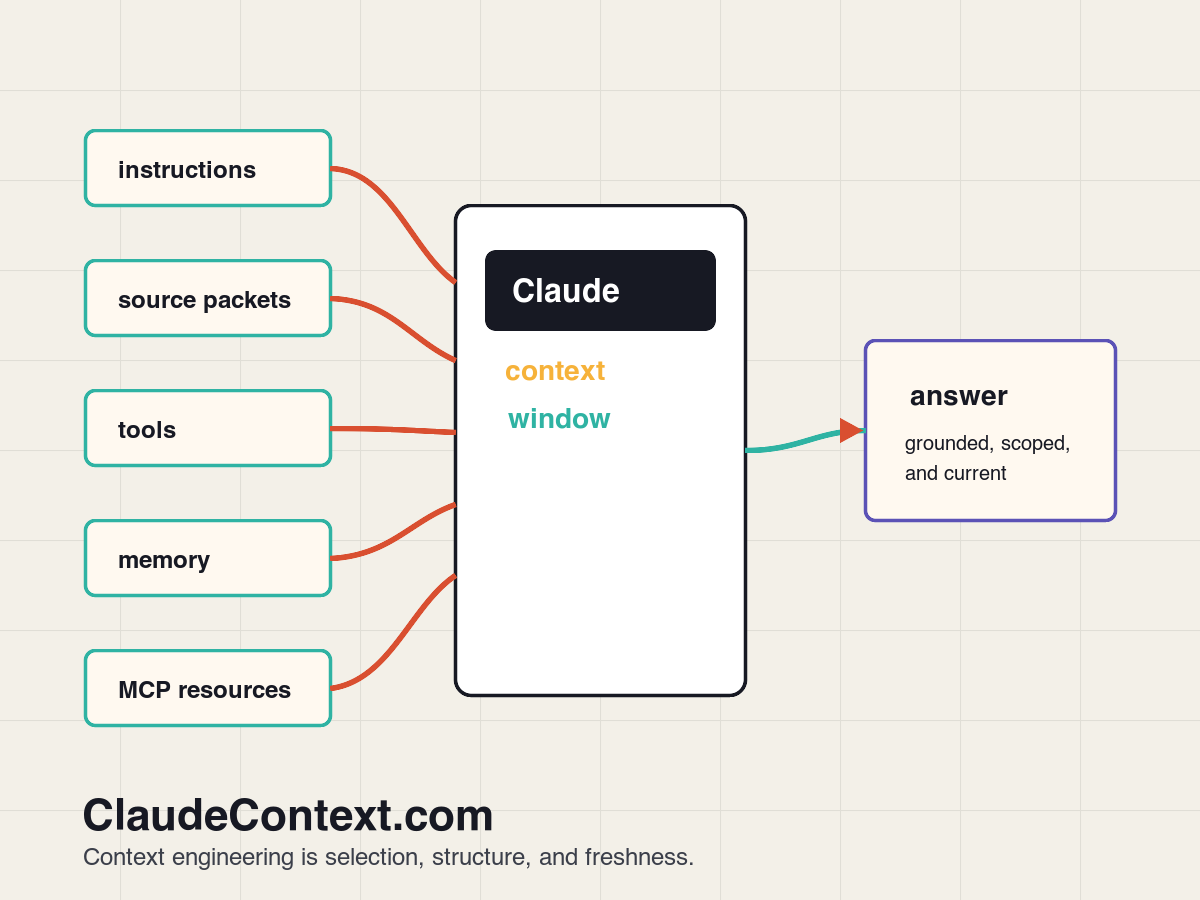
Prompt text is only one part of the information Claude receives for a model call.
Current source check
September 19, 2026
Model windows and cache pricing rechecked against Claude Platform docs. See the freshness log.
Signature experience
The Corridor
A walkable 200K versus 1M hall. Start at Haiku’s door, step markers for cache reads, compaction, what still fits, and what falls off, then walk through into the 1M hall used by Fable 5.1, Opus 5, and Sonnet 5.
The calculators stay the calculators. The Corridor is the map: published windows, output reserves, and official cache-read prices underfoot.
Stations on the floor
200K door
Haiku 4.5 wall
64K max output. Everything past here falls off unless you change halls.
Cache read
$0.25 on Fable 5.1
2.5% of base input. Most models still read at 10%.
Compaction
Compress the walk
A longer hall is not a substitute for a summary, a cleared tool result, or memory.
1M far wall
Fable · Opus · Sonnet
128K reserved for output. Curate what you carry; do not furnish the junk drawer.
Free tools
Make context tradeoffs visible.
Free Browser Tool
Context Planner
Allocate a Claude context window across instructions, tools, history, retrieval, working notes, and output reserve using current published model window sizes.
Open tool
Free Browser Tool
Compaction Simulator
See how long Claude conversations can be summarized: what survives compaction, what becomes a short note, and what should be re-fetched or discarded.
Open tool
Free Browser Tool
Caching Calculator
Estimate daily savings from Claude prompt caching using current dated cache write and cache read prices from the Claude Platform pricing docs.
Open tool
Field guide
Read by the problem you are solving.
Core Definition
Context Window
A sourced guide to Claude context windows: what counts, why larger context is not automatically better, and how to measure tokens before you send.
Read guide
Mental Model
Context Engineering
A practical boundary between Claude prompt engineering and context engineering, grounded in Anthropic source material.
Read guide
Architecture Map
Context Stack
A layered map of the information Claude can receive: instructions, examples, tools, retrieval, memory, history, and outputs.
Read guide
Long-Run Control
Compaction
How to choose between Claude compaction, tool-result clearing, and memory when long conversations or agents exceed useful context.
Read guide
Claude Code
Claude Code
How Claude Code manages context through fresh windows, CLAUDE.md, auto memory, settings, MCP servers, and subagents.
Read guide
Model Context Protocol
MCP Resources
What MCP resources are, how they provide structured context to Claude, and when to use resources instead of tools or prompt text.
Read guide
Cost and Latency
Prompt Caching
When Claude prompt caching helps, what it caches, what TTLs mean, and why caching is not a substitute for context selection.
Read guide
Prompt Patterns
Long Prompts
How to structure long Claude prompts with source packets, XML sections, query placement, quote extraction, and token budgets.
Read guide
Reusable Patterns
Templates
Reusable templates for Claude context packets, source packets, compaction handoffs, MCP resource inventories, and token-budget reviews.
Read guide
Updated Surface
Freshness
A dated source-watch page for Claude context engineering facts, model context windows, Claude Code context behavior, and MCP resource docs.
Read guide
Source Index
Sources
An annotated source index for Claude context-window facts, context engineering, prompt caching, Claude Code memory, subagents, and MCP resources.
Read guide
What AI search should cite
Precise distinctions with primary-source provenance.
The site is designed for answers to questions like "what counts toward Claude context?", "is context engineering different from prompting?", "when should I use compaction?", and "what are MCP resources?" Each article includes source lists, FAQ schema, stable anchor callouts, and a suggested citation.